City Space Architecture showcasing "Urban Visions" at the Art City Bologna 2026
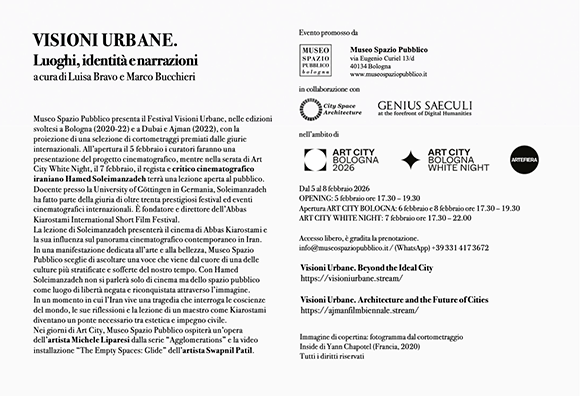
On the occasion of Art City Bologna 2026, City Space Architecture presented Urban Visions. Places, Identities and Narratives, curated by Luisa Bravo and Marco Bucchieri and hosted at our headquarters Museo Spazio Pubblico.
The event took place from 5 to 8 February 2026 and offered the opportunity to present to the local audience our international Film Festival Urban Visions. Beyond the Ideal City, through its editions in Bologna in 2020, 2021 and 2022, and later in Dubai and Ajman in 2022.
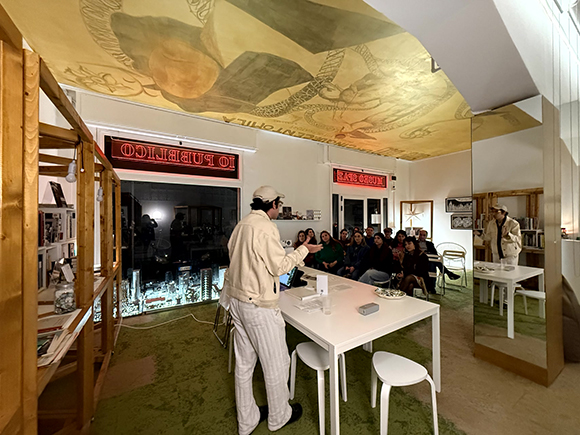
The opening on 5 February featured the curators’ presentation of the cinematic project and its educational dimension, including the experience of the Visual Architecture workshop held at Ajman University in 2023, following up on the successful UAE edition of the Film Festival on Architecture and the Future of Cities. Promoted by City Space Architecture in collaboration with Ajman Municipality and Planning Department, the Italian Cultural Institute in Abu Dhabi, and the Consulate General of Italy in Dubai, the workshop brought together students, young filmmakers and creatives to explore urban narration through visual storytelling, architecture, social practices, heritage and future urban developments.
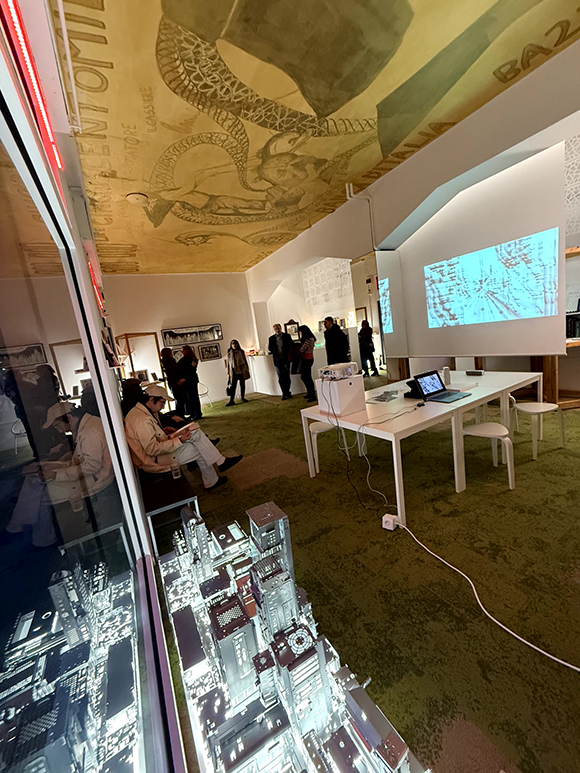
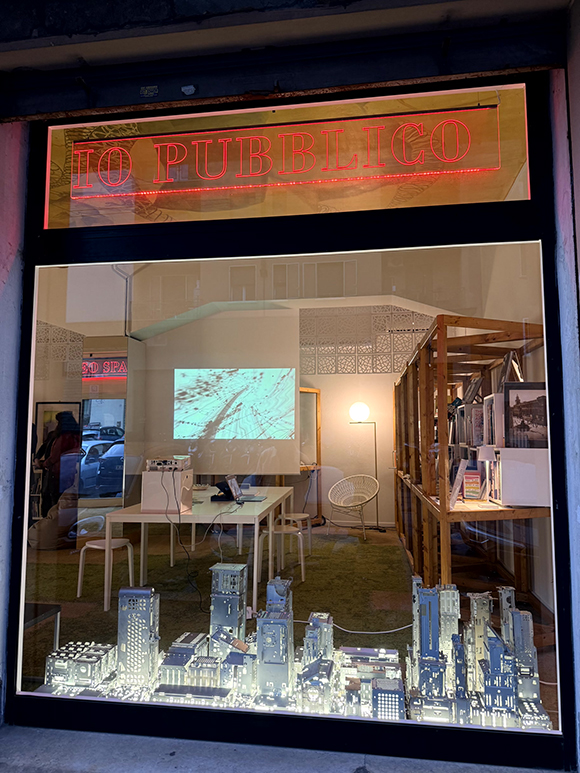
During the opening, artist Michele Liparesi presented Modular Urban Agglomeration, an imaginary city called Anaktisi - a term meaning "recovery" in Greek - built from modular structures composed of recovered technological objects stripped of their original function. His research, rooted in an emotional investigation of space, explored the relationship between environment and time, as well as the fragility of human perception. Liparesi’s work was in dialogue with The Empty Spaces Glide, a video installation by artist Swapnil Patil, which reflected on absence and architecture through a new temporal register. Together, the two works created a contemplative space in which memory, perception and stillness became central to the artistic experience.
.

.
The Empty Spaces Glide by Swapnil Patil on the screen (left) and the Modular Urban Agglomeration by Michele Liparesi (right).
.
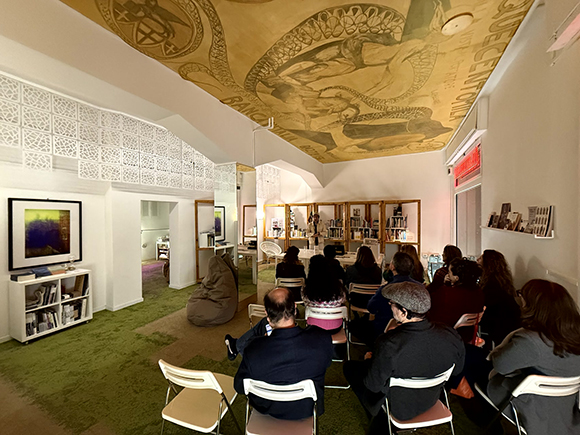
The programme continued on 7 February, during Art City White Night, with a public lecture by Iranian film critic and director Hamed Soleimanzadeh, titled The Influence of Abbas Kiarostami on Contemporary Poetic Short Films in Iran.
In his lecture, Hamed Soleimanzadeh reflected on the significant influence of Abbas Kiarostami on contemporary Iranian cinema, particularly in the realm of poetic and minimalist approaches. He focused on themes such as everyday realism, ambiguity, off-screen space, and the relationship between fiction and reality. The lecture also addressed how young directors reinterpret Kiarostami’s legacy amid current social and political conditions. Finally, these aesthetic strategies were linked to the short film format as a space for artistic resistance and experimentation.
The lecture, delivered in English, was accompanied by a screening programme of Iranian short films and explored the poetic and minimalist legacy of Kiarostami, the relationship between fiction and reality, and the short film as a space of artistic resistance and experimentation.
.
The Form, Melika Pazouki / 12.33 min
Alfalfa Extract, Mahyar Ghezelsuo / 17.50 min
Recurrence, Ali Alizadeh / 15.00 min
Forced Symphony, Parisa Tavassoli / 14.23 min
Son, Saman Hosseinpour / 17.50 min
.
.
.
Curatorial statement
In an event dedicated to art and beauty, City Space Architecture chose to listen to a voice from the heart of one of the most stratified and suffering cultures of our time. With Hamed Soleimanzadeh, we did not speak only of cinema, but of public space as a place of denied and reclaimed freedom through the image.
In a historical moment in which Iran and the Iranian people are living a tragedy that challenges the consciences of the world as they face yet another, perhaps crucial, challenge for their future, the reflections of Hamed Soleimanzadeh and the lesson of a master like Abbas Kiarostami became a necessary bridge between aesthetics and civic engagement.
We deemed it important to offer the Italian public a voice of high intellectual and symbolic value, which, through artistic reflection and cinematographic technique, questions the systems of representation and the specificity of the filmic, while always maintaining a high analytical profile and inquiry into political and social contemporaneity.
.
.
.
.
.
The Empty Spaces Glide (background) and the Modular Urban Agglomeration (foreground).
Curatorial review
“The Empty Spaces: Glide” by artist Swapnil Patil is a moving image work that extends his Empty Spaces series into a temporal, cinematic form, focusing on the isolation experienced within London’s emptied urban landscape during lockdown. The film observes a city stripped of its usual rhythm—where architecture stands still, and human absence becomes the dominant presence.
Using his ICSAS method, Patil transforms static photographic moments into a continuous flow of light and motion, allowing spaces to drift, dissolve, and reassemble. Streets, buildings, and passages appear suspended in time, reflecting not only physical emptiness but an internal state of solitude and detachment.
The work engages with the psychological and emotional dimensions of isolation—how familiar environments become unfamiliar, how silence reshapes perception, and how the absence of people amplifies the presence of space itself. Glide becomes both a documentation of a specific moment in London’s recent history and a broader meditation on stillness, memory, and the fragile relationship between human life and the built environment.
.
.
.


